
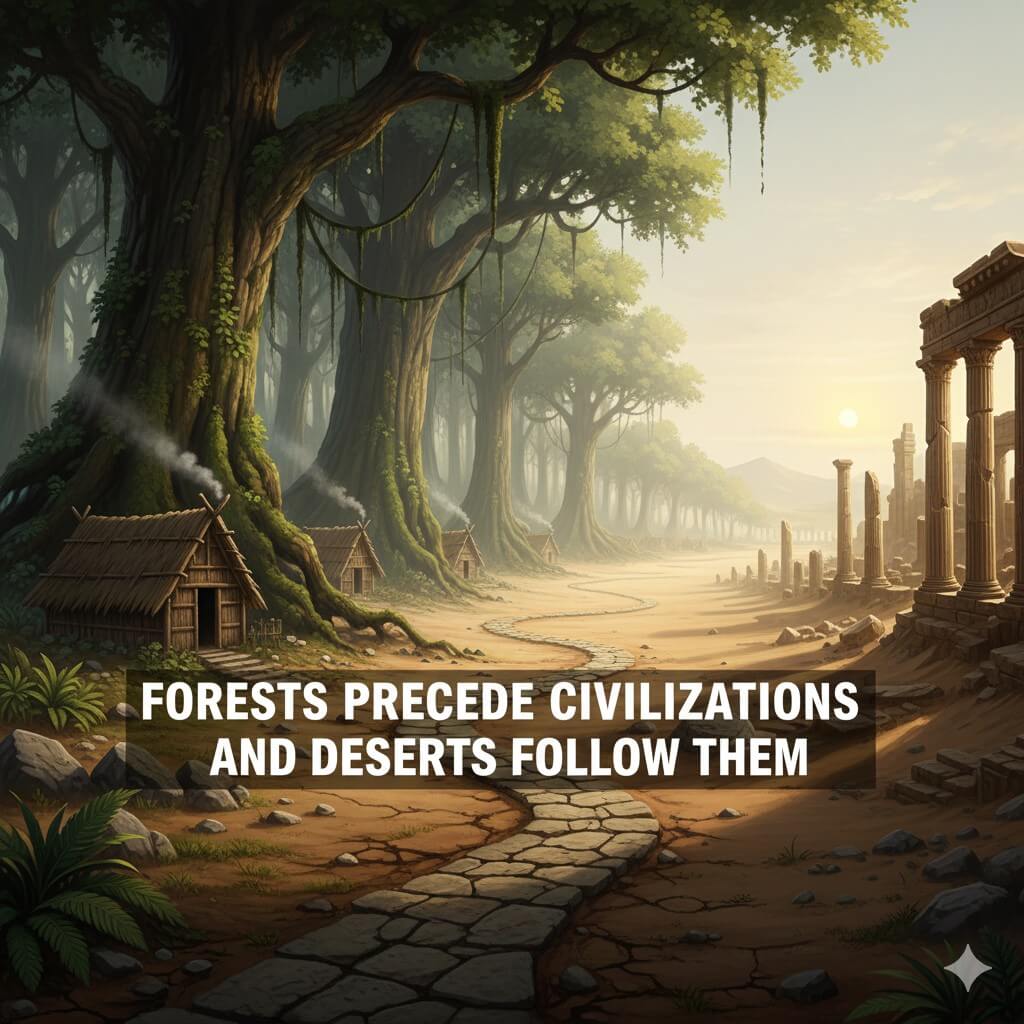
There’s an old saying that goes “Forests precede civilizations and deserts follow them.” At first, this might sound like just another proverb, but when you think about it deeply, it tells us a tragic story about humanity’s relationship with nature. This simple statement captures what has happened over and over again throughout human history—we arrive at lush, green places, build our cities and towns, use up all the natural resources, and leave behind barren land.
When we talk about civilizations, we mean organized human societies that have developed cities, farming, technology, art, and culture. Civilizations are what we’re proud of as humans—they show our ability to build, create, and progress. We look at tall buildings, highways, and factories and feel accomplished. But rarely do we stop to think about what we destroyed to build all of this.
Forests are nature’s own masterpieces. They’re not just groups of trees standing together. A forest is a complete world of its own—tall trees, smaller plants, animals, insects, birds, rivers, and streams all living together in perfect balance. Forests have been around much longer than humans. They keep our air clean, bring rain, hold the soil together, and give homes to countless creatures. A single large tree can provide oxygen for four people for an entire year.
The saying tells us about a pattern that keeps repeating. First, there’s a beautiful forest full of life. Then humans come and settle there because the land is fertile. Slowly, they cut down trees to build homes, to farm, to cook food, and to make room for more people. The civilization grows and becomes successful. But after years of cutting trees and using up the land without giving anything back, what’s left behind is damaged, dry land that can barely support life anymore. The very success of the civilization plants the seeds of its own destruction.
Think about it like a bank account full of money. You keep withdrawing from it to buy things you need. You’re doing well, getting everything you desire. But you never deposit anything back. Eventually, the account runs dry. That’s exactly what happens with forests and civilizations. We keep withdrawing trees, soil nutrients, water, and wildlife, but we rarely put anything back until it’s too late.
This pattern shows something important about how we humans think. We’re very good at taking what we need from nature, but we’re not so good at giving back or thinking about the future. Each generation thinks there’s enough, that someone else will fix the problem, or that technology will somehow save us.
We see trees and think “timber.” We see land and think “farms.” We forget that these things are connected like a spider’s web. When you remove trees, the rain doesn’t come as regularly. When rain doesn’t come, rivers dry up. When rivers dry up, the land becomes parched. When land becomes dry, people can’t grow food. When people can’t grow food, they have to leave. It’s all connected, like dominoes falling one after another.
India’s history is full of examples of this destructive pattern. Long ago, the Indus Valley civilization built amazing cities like Harappa and Mohenjo-Daro with proper streets and drainage systems. But these cities needed millions of bricks, and making bricks requires lots of fire, and fire needs wood. So they cut down forests for fuel, day after day, year after year, century after century. Today, if you visit those areas, you’ll find them quite dry and barren. Scientists believe that part of the reason this great civilization disappeared was because they destroyed their own environment. There was even a mighty river called Saraswati that ancient texts mention—it’s completely gone now.
Look at Rajasthan today. The Aravalli Hills used to be covered with thick forests. People cut them down over centuries for mining, for wood, and to make space for grazing animals. Now much of that area is bare rock and sand. The Thar Desert keeps spreading eastward, partly because we removed the trees that were protecting the land like a natural barrier. Even in recent times, we’ve seen forests in central India and the Western Ghats being cut down for development projects, mines, and expanding cities. Every time we lose a forest, we lose a little bit of our future—less rain, more heat, and more conflicts between humans and wildlife who have nowhere else to go.
This pattern isn’t unique to India—it’s happened across the world. The Middle East, now mostly desert, was once the fertile Crescent covered with cedar forests and productive farmland. Ancient civilizations cut down trees for temples and ships, and the soil washed away without roots to hold it. North Africa once fed the Roman Empire with grain; now it’s largely Sahara Desert. Greece and Rome were forested until trees were felled for cities and warships, leaving behind the eroded, water-scarce landscapes we see today. Everywhere humans settled and prospered, forests disappeared and deserts followed.
When we destroy forests, we set off a chain reaction of problems. First, animals and plants disappear. Some species go extinct forever. Then the climate starts changing—less rain, more extreme temperatures, unpredictable weather. The soil starts washing away. What took thousands of years to form can be lost in a few seasons. Rivers that flowed year-round become seasonal. Wells and ponds dry up. Farmers struggle because the land isn’t productive anymore.
When farming fails, people become desperate. They leave their ancestral homes and move to overcrowded cities looking for work. Sometimes, when resources become scarce, people fight over what little remains—water, land, grazing rights. Many historians believe some ancient civilizations collapsed partly because they destroyed their own environment and couldn’t recover.
But here’s the good news—we don’t have to keep repeating this mistake. Unlike our ancestors, we now understand what’s happening. We have the knowledge and tools to do things differently. We can protect the forests we still have and bring back the forests we’ve lost. It won’t be easy, and it won’t happen overnight, but it’s absolutely possible if we commit to it.
All around the world, people are planting trees and seeing real results. In India, communities are coming together to protect and regrow forests. Women in rural areas are forming groups to plant saplings and protect them. In China, they’re creating a “Great Green Wall” of trees to stop deserts from spreading. African countries are planting millions of trees across the continent to push back the Sahara.
These efforts are actually working. When people plant trees and protect them for just ten or fifteen years, forests can come back even in areas that seemed completely destroyed. Trees grow, birds return, animals come back, rain becomes more regular, and the land heals itself. It’s like watching a miracle in slow motion.
The old saying about forests and deserts doesn’t have to be our destiny. We can write a different story for the future. We can be the generation that breaks this ancient cycle of destruction and becomes known for restoration instead. Every tree planted is a step in the right direction. Every forest protected is a gift to our children. Every person who chooses to care about nature makes a difference, and when millions of people make small changes, the impact becomes enormous.
Our civilization’s legacy shouldn’t be deserts and barren land. It should be thriving forests that we protected and restored, ensuring that life continues to flourish long after we’re gone. That’s the future worth working for, and it’s still within our reach if we act now with wisdom, commitment, and hope.