
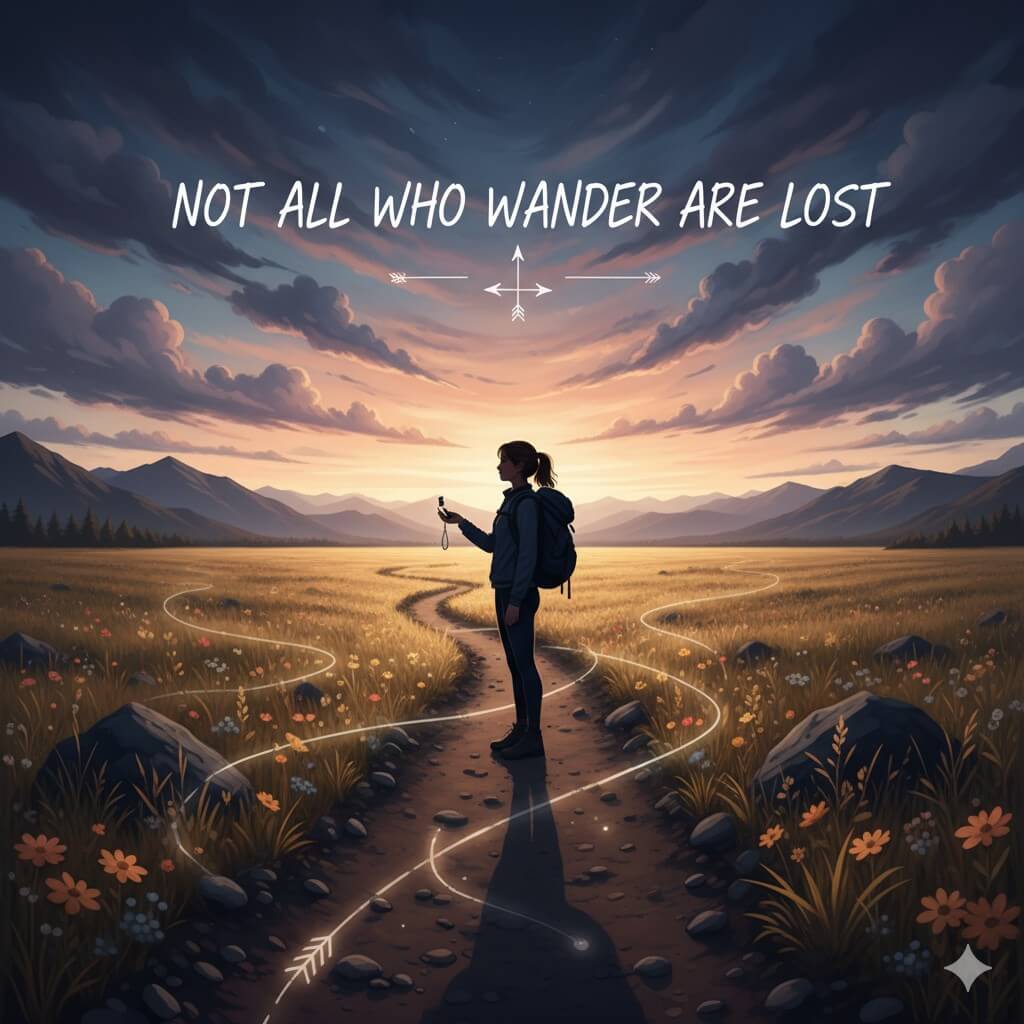
The saying “Not all who wander are lost” was coined by J.R.R. Tolkien in his poem “The Riddle of Strider” from The Lord of the Rings. It challenges the assumption that deviating from a set path signifies a lack of purpose, suggesting instead that personal growth and valuable insight may arise from unconventional journeys.
Many assume that wandering reflects a lack of direction or purpose, but that’s not always the case. In truth, wandering can be an intentional act of exploration—a journey of learning, self-discovery, and growth. Those who step away from the straight, predictable path often do so to seek deeper meaning and personal freedom. Wandering, then, isn’t about confusion or aimlessness—it’s about embracing the journey and trusting that growth often happens in unexpected places.
When we wander, we begin to depend more deeply on ourselves. Without the safety of routine or familiar surroundings, we’re forced to make our own choices and face challenges head-on. A traveler navigating a new city alone must plan, adapt, and decide independently—skills that naturally build confidence and self-trust. The same happens in everyday life when someone changes careers, starts over, or takes a leap into the unknown. Each decision made along the way strengthens their sense of independence, teaching them to rely on their own wisdom and resilience.
Wandering also nurtures resilience—the ability to recover from setbacks and keep moving forward. Life rarely unfolds as expected, and those who wander know this well. Every obstacle faced along the way becomes a lesson in endurance. Like a tree that bends without breaking in the wind, wanderers learn how to adapt, heal, and grow stronger after each trial. This strength prepares them for greater challenges, proving that persistence often matters more than certainty.
Another gift of wandering is the development of creative problem-solving. Stepping into unfamiliar territory—whether physical or intellectual—forces us to think in new ways. An explorer who encounters a blocked trail must find another route, just as someone experimenting with a new skill or idea must look beyond what they already know. This constant need to adapt sharpens the mind and encourages flexible thinking. Over time, wanderers become adept at meeting life’s surprises with imagination and confidence.
Exploration also widens our perspectives. Meeting people from different cultures or learning unfamiliar ideas opens the mind to fresh possibilities. It nurtures empathy and understanding by showing us how others think, live, and dream. Traveling to new places or studying new subjects can reshape how we view the world—and ourselves. This openness helps us connect more deeply with others and handle life’s diversity with grace and compassion.
Personal growth may be the greatest treasure found through wandering. As we explore uncharted paths, we come to understand ourselves more clearly—our strengths, passions, and true priorities. The moments when we feel uncertain or “lost” often turn out to be the most meaningful, revealing who we really are. Such experiences teach us that uncertainty isn’t a failure but an essential step toward maturity and self-awareness.
Wandering isn’t only about physical movement; it can also mean exploring new ideas, emotions, or creative directions. Many great artists, thinkers, and seekers have recognized that stepping away from what’s familiar can awaken inspiration and insight. Sometimes, being “lost” simply means being open—to new knowledge, perspectives, and inner transformation. In that sense, wandering is a conscious act of courage, not a sign of confusion.
Perhaps the greatest wisdom gained from wandering is perspective. Leaving the familiar behind allows us to see life from new angles. Writers, scientists, and philosophers often find their deepest insights during times of solitude or exploration—when their minds are free from routine. It’s in these in-between moments, where the old and new overlap, that understanding deepens and creativity blossoms.
Ultimately, wandering is not a lack of direction but a different kind of direction—one guided by curiosity, faith, and self-growth. It’s the courage to take a path that isn’t straight, trusting that each twist and turn brings us closer to wisdom. As our world becomes faster and more uncertain, the message of “Not all who wander are lost” feels more relevant than ever. It reminds us that exploration—both outward and inward—is often what leads us home to ourselves.
Even science echoes this truth. Neuroscience shows that when our minds wander—a state known as the brain’s default mode network—we become more creative, reflective, and emotionally balanced. Mental wandering allows us to connect ideas in new ways and find solutions that focused thinking sometimes misses. In this sense, both physical and mental wandering are powerful tools for personal growth and emotional well-being.
In the end, wandering invites us to live more fully. It teaches us to trust the process, face uncertainty with grace, think creatively, and appreciate the beauty of discovery. It shows that the journey itself—no matter how winding—is what shapes us into wiser, more compassionate, and more complete human beings.
Additional Reads
Disclaimer: This write-up is a collection of facts and insights compiled purely for educational purposes. Readers are encouraged to explore further information through independent online research.