
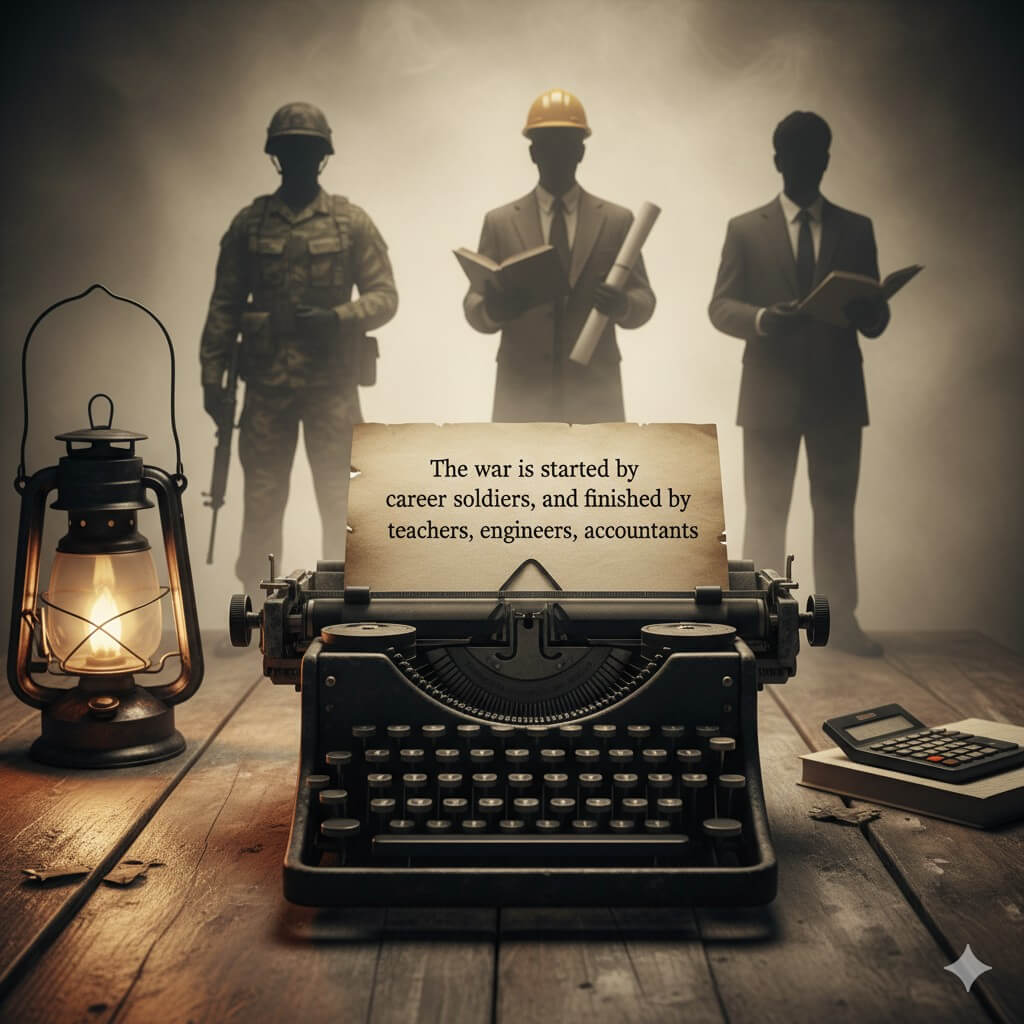
This profound quote by General Valery Zaluzhny, the former Commander-in-Chief of Ukraine’s Armed Forces, captures a deep truth about how wars both begin and end. It reminds us that while soldiers are responsible for fighting and defending their nations, the real and lasting work of peace belongs to ordinary citizens — teachers who rebuild minds, engineers who rebuild cities, and accountants who restore order to economies. Zaluzhny’s words offer more than a comment on warfare; they express a broader understanding of how societies are torn apart and then put back together, showing that true victory is achieved only when people rebuild and heal their country.
Zaluzhny’s observation draws a clear line between those who start wars and those who ultimately finish them. The phrase “career soldiers” refers to trained military professionals — the individuals who study the art of strategy, command armies, and execute plans designed to defend their nations or pursue political goals. They are experts in tactics, discipline, and sacrifice, operating in a world of risk and uncertainty where every decision can mean the difference between survival and defeat.
In contrast, the “teachers, engineers, and accountants” in his statement symbolize the millions of civilians who take on the immense responsibility of rebuilding once the fighting stops. They represent the moral and social backbone of society — people whose work may seem ordinary, yet without whom no nation could recover from the destruction of war. Teachers educate children who have lost years of schooling and help them overcome trauma, ensuring that knowledge and critical thinking survive even in dark times. Engineers reconstruct the physical world — roads, bridges, schools, hospitals, and homes — creating the foundation on which normal life can begin again. Accountants and other financial professionals restore order to shattered economies, managing aid, balancing budgets, and ensuring that resources are used wisely. Through their everyday dedication, civilians transform the devastation of war into a new beginning, turning loss into progress.
Zaluzhny’s message is, at its heart, a reminder that real victory does not come from weapons alone. The end of combat marks only the beginning of another kind of struggle — the long and difficult process of healing. War may destroy, but peace must rebuild, and that second task is even harder. Soldiers can win battles, but it is citizens who win peace.
To truly understand the depth of this statement, it helps to know more about General Valery Zaluzhny himself. Born in 1973 into a military family, Zaluzhny grew up surrounded by discipline, duty, and service. He was educated in some of Ukraine’s best military academies and rose through the ranks through talent and leadership rather than privilege or politics. When he became Commander-in-Chief of Ukraine’s Armed Forces, he brought with him a modern vision of warfare — one that emphasized flexibility, technology, and trust in subordinates. His leadership during the Russian invasion of Ukraine marked a major shift away from rigid, top-down systems inherited from Soviet times. Instead, he promoted initiative and adaptability, empowering frontline officers to make quick decisions.
What made Zaluzhny stand out was not just his military skill but his humanity. He recognized that wars are not only fought on battlefields but also in the hearts and minds of people. He understood that while armies defend nations, societies must sustain them. His words about teachers, engineers, and accountants are not simply poetic; they are drawn from real experience — from witnessing how, even amid conflict, civilians kept Ukraine alive by continuing to teach, repair, and manage.
The beginning of any war is almost always the work of political and military elites. Governments decide to fight for reasons that may include defending borders, securing independence, or achieving strategic goals. Soldiers then carry out these decisions, following orders with professionalism and discipline. Their training prepares them for the harsh realities of battle — to lead troops, to execute complex strategies, and to withstand immense physical and psychological pressure. In this early phase, the focus is on survival and defense, but war inevitably brings destruction. Cities fall silent, economies collapse, and human suffering spreads. Even when the fighting is justified, the cost is always enormous.
When the guns finally fall silent, the hardest phase begins — the long and often invisible work of rebuilding. This is when Zaluzhny’s “teachers, engineers, and accountants” step forward. Their efforts do not make headlines, but they are what transform the aftermath of war into the possibility of peace. Teachers are among the first to restore a sense of normal life. In classrooms that may still bear scars of violence, they help children rediscover curiosity, rebuild confidence, and prepare to become responsible citizens. Education becomes an act of recovery, nurturing hope in young minds that have seen too much despair.
Engineers, meanwhile, become the architects of renewal. They repair broken power grids, restore bridges and hospitals, and ensure that people have access to clean water, shelter, and transport. Their work is the physical manifestation of peace — proof that a nation is not only surviving but rebuilding itself. Accountants and financial experts take on another kind of battle: the fight to bring stability back to an economy in chaos. They manage international aid, design recovery budgets, prevent corruption, and rebuild trust in institutions that were weakened by war.
Together, these professions — and countless others like them — turn a fragile ceasefire into lasting peace. Their work ensures that the sacrifices made on the battlefield are not wasted. They show that courage takes many forms — not only in facing bullets but in rebuilding broken systems, guiding children, or balancing the fragile finances of a recovering nation.
Zaluzhny’s insight also touches on a deeper truth: war changes every part of society. It alters not just geography and infrastructure but also national identity, governance, and values. A country that has endured conflict must rediscover what it means to live in peace. Victory on the battlefield is not enough if social trust is lost or if communities remain divided. Without rebuilding education, governance, and economy, even a military triumph can turn hollow. The institutions represented by teachers, engineers, and accountants — education, innovation, and organization — are the true foundations of long-term stability.
Ukraine’s experience provides a powerful example of Zaluzhny’s words in action. As soldiers defend the nation’s borders, civilians play an equally crucial role behind the lines. Teachers continue classes online or in shelters during air raids, determined to keep learning alive. Engineers work tirelessly to repair bridges, roads, and energy systems damaged by attacks. Public servants ensure that hospitals function, pensions are paid, and aid reaches those who need it. In the face of destruction, ordinary Ukrainians have demonstrated extraordinary resilience, showing that war can be fought and peace sustained only through the combined strength of both soldiers and civilians.
Zaluzhny’s quote, therefore, carries a message not only for Ukraine but for the entire world. It reminds us that war and peace are two chapters of the same story — one written in sacrifice, the other in perseverance. Soldiers protect and defend, ensuring that a nation survives; civilians rebuild and sustain, ensuring that it thrives. For peace to last, both sides of this equation must work together. Governments and international organizations must understand that preparing for peace is as important as preparing for war. Policies should focus not only on military strength but also on education, infrastructure, and economic resilience — the tools that make recovery possible.
In the end, Zaluzhny’s statement expresses a timeless truth about humanity. Wars may begin with weapons and strategies, but they can only truly end with compassion, knowledge, and cooperation. Soldiers may win the immediate victory, but it is teachers, engineers, and accountants — and all the ordinary citizens they represent — who build the enduring one. They are the quiet heroes of every nation, proving that peace is not a gift but an achievement earned through patient, collective effort.
In the end, Zaluzhny’s statement expresses a timeless truth about humanity. Wars may begin with weapons and strategies, but they can only truly end with compassion, knowledge, and cooperation. Soldiers may win the immediate victory, but it is teachers, engineers, and accountants — and all the ordinary citizens they represent — who build the enduring one. They are the quiet heroes of every nation, proving that peace is not a gift but an achievement earned through patient, collective effort.
Thus, General Valery Zaluzhny’s words remind us that the measure of a nation’s strength is not only its ability to fight, but its capacity to rebuild, educate, and care. Soldiers may start the war, but only citizens can finish it. Together, they form the living heartbeat of a country — its will to endure, its power to recover, and its hope to rise again.
References
Additional Reads
Nothing is More Powerful Than an Idea Whose Time Has Come
https://toaike.com/wp-admin/post.php?post=3810&action=elementor